
Why I Started Learning to Write by Hand Again
I don’t think I ever actually learned how to use my hand properly. I learned how to write, obviously, because everyone has to go through school and fill out worksheets and write exams and sign forms, but I never really thought about what my hand was doing while I was doing it. I held a pen the way I had always held a pen, pushed it around the page, and assumed that if the words were readable, then everything was fine. Nobody ever explained why my fingers were doing most of the work, why my wrist would get tired, or why my handwriting became progressively worse whenever I had to write more than a page. Looking back, it’s kind of ridiculous that I spent years learning how to write words without ever learning how to actually control the thing that was making the words. I knew how to spell, I knew how to construct sentences, and eventually I learned how to type ridiculously fast, but I had almost no understanding of the physical skill sitting underneath handwriting. Apparently, I had been writing for decades without knowing how to write.
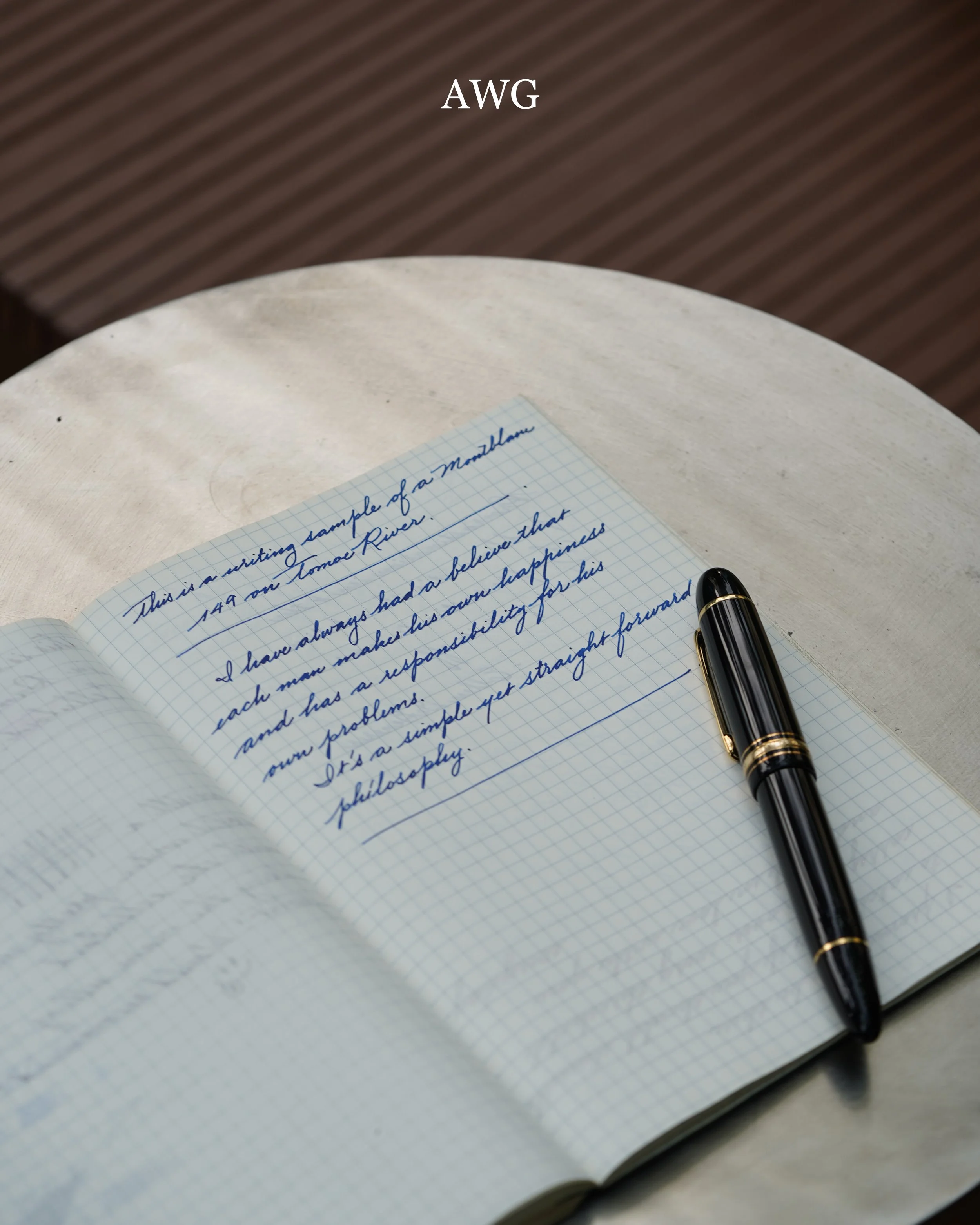
And then we entered the wonderful age of artificial intelligence, where even the things I used to struggle with can now be done by asking a box to do them for me. I can type a few vague thoughts into ChatGPT and suddenly have an email, an article, a lesson plan, a caption, a summary, or a perfectly structured paragraph that I definitely did not have ten minutes ago. I’m not complaining about that because, frankly, I use AI all the time and it has saved me an absurd amount of work. But every now and then I have this slightly annoying thought: if a machine can help me think, write, draw, organize, calculate and communicate, what exactly am I still supposed to do with my own two hands? I can already feel myself becoming the kind of person who gets annoyed when an app takes three seconds to load, while simultaneously having no idea how to make a decent handwritten capital G. That feels like a strange trade-off. The more capable our digital tools become, the more interesting it is to me that some very basic physical skills are quietly disappearing from everyday life.
I noticed this properly when I started paying attention to my own handwriting. I would sit down with a pen and immediately do what most people probably do: grip the thing like it owed me money, press way too hard, move almost entirely from my fingers, and then wonder why my hand felt exhausted after twenty minutes. The stupid part was that I didn’t even realize I was doing anything wrong. I thought handwriting was supposed to feel like that because that’s how it had always felt. Then I started watching people who had clearly spent years practicing, and their hands were doing something completely different. The pen seemed to move across the page instead of being dragged across it, the letters had rhythm, and the whole thing looked strangely effortless. Meanwhile, I was sitting there producing one miserable sentence while holding my pen with the intensity of a surgeon performing emergency surgery. That was probably the moment I became interested in handwriting as a physical skill rather than simply a way of making words legible.
The more I looked into it, the more I realized that “handwriting” isn’t really one thing. There are different traditions, different movements, different tools, different proportions, different ways of thinking about rhythm and spacing, and completely different expectations of what the finished page should look like. I had somehow gone through my entire education believing that handwriting was basically a binary system: either your handwriting was neat or it was ugly. Apparently there was an entire universe sitting behind that assumption, and nobody had bothered to tell me. Once I started exploring it, I became interested in three styles in particular: Business Cursive, Copperplate and Cursive Italic. They look different, they feel different, and more importantly, they ask my hand to behave differently. That made me realize that learning handwriting could be less like fixing ugly letters and more like learning three different physical languages.
Business Cursive was probably the first style that made sense to me because it brought the idea of movement into the picture. Instead of treating every letter like a separate little drawing, I started thinking about how the hand travels through an entire word. Suddenly things like rhythm, spacing, slant and arm movement became more important than obsessing over whether one particular loop looked perfect. This was a pretty humbling realization because I had spent years thinking that handwriting was mostly about having nice-looking letters. It turns out that you can have individually beautiful letters and still produce handwriting that looks terrible when they are placed together with inconsistent spacing and awkward movement. Business Cursive made handwriting feel more practical, but it also made it feel more physical. For the first time, I wasn’t just trying to make my handwriting prettier; I was trying to make the act of writing itself feel less stupidly difficult.
Copperplate was where things got a little more serious. I remember initially looking at Copperplate and thinking, “Absolutely not, I’m not doing that.” The letters looked too elegant, too precise and frankly a little intimidating, especially when I was still struggling to keep my everyday handwriting consistent. Then I realized that this was exactly why it was interesting. Copperplate forced me to slow down and actually pay attention to pressure, direction, rhythm and the relationship between thick and thin strokes, and suddenly the pen stopped feeling like a disposable plastic stick and started behaving more like an instrument. There is something slightly ridiculous about spending ten minutes practicing one stroke that takes half a second to write, but that’s also the point: the exercise makes you aware of what your hand is actually doing. In a world where I can ask AI to generate an entire page of beautiful text before I have finished my coffee, sitting there trying to produce one good stroke with a pointed pen feels almost offensively slow.
Cursive Italic landed somewhere in between those two experiences for me. It has structure and discipline, but it doesn’t feel as ornamental or formal as Copperplate, and it still has enough movement to feel like handwriting rather than drawing. I liked that it could be practical without becoming boring and expressive without requiring every letter to look like it belonged on a wedding invitation. It also made me think about how much personal preference matters when it comes to handwriting. Some people want something fast and functional, some people are fascinated by the precision of traditional calligraphy, and some people want something that sits comfortably somewhere between the two. There isn’t really a single “best” handwriting style because the reason you are writing matters just as much as what you want the letters to look like. Cursive Italic made that particularly obvious to me because it felt like a style I could actually live with rather than simply admire on someone else’s page.
That’s ultimately why I think having three different handwriting styles makes more sense than trying to find one universal system. Business Cursive can teach me how to move through everyday writing with more ease and consistency, while Copperplate can teach me patience, pressure control and precision, and Cursive Italic can give me a more flexible middle ground between function and expression. They aren’t three versions of the same thing, and I don’t think someone needs to learn all three in order to become “good” at handwriting. In fact, I think the opposite is more interesting: learning different styles gives you the opportunity to figure out what kind of writer you actually enjoy being. One person might want to fill pages quickly, another might enjoy the ridiculous concentration required to make perfect Copperplate strokes, and someone else might simply want their journal to look a little more like their own handwriting instead of something produced by a tired office printer. The point isn’t to find the correct style; it’s to discover what your hand enjoys doing.
I also don’t think any of this means we need to reject technology or pretend that handwriting is somehow morally superior to typing. That argument gets old very quickly, and I have absolutely no intention of writing an entire article by hand just to prove a point. I like keyboards, I like phones, and I like having an AI assistant that can help me turn a pile of half-formed thoughts into something coherent. What I find interesting is what happens when handwriting becomes something I choose to do rather than something I am forced to do. When nobody is making me write three pages in a notebook, the physical act becomes strangely enjoyable. I can slow down, make mistakes, change my grip, experiment with a different pen, and notice how my hand behaves when I’m not desperately trying to finish an assignment before the bell rings.
Maybe that’s what I was actually missing. I didn’t need another productivity system, another app, another perfectly optimized workflow or another machine telling me how to do things faster. I needed to spend a little time doing something badly with my own hands and gradually getting better at it. Business Cursive, Copperplate and Cursive Italic are three very different ways into that process, and that’s exactly why I find them interesting together. One teaches movement, one demands precision, and one sits comfortably between structure and expression. In an age where almost anything can be generated, corrected or automated in seconds, there is something satisfying about putting a pen on paper and knowing that the line exists because I physically made it. It is slower, less efficient and occasionally quite frustrating, but maybe that is precisely why I want to keep doing it.
