
Every fountain pen hobby has its rabbit hole.
Mechanical pencils have vintage drafting pencils. Watches have Swiss movements. Cameras have Leica lenses - and in the fountain pen world, it’s flex nibs.
At some point, almost everyone becomes convinced that this is where the magic happens.
I definitely did.
I remember spending hours watching videos of vintage Watermans opening up into these gorgeous hairlines and swells. Every review seemed to promise something slightly softer than the last one. Every forum thread had someone saying, “You haven’t experienced a real flex nib until you’ve tried…” and then they’d mention some pen that’s been out of production for eighty years and somehow costs more than my first month’s rent.
So naturally, I wanted one. A Duofold.
Then another. A Wahl’s.
Then a softer one. A Justus.
Then a vintage one because apparently modern flex “doesn’t count.”
It’s funny how quickly the hobby changes without you noticing. You start because you want to write more, but somewhere along the way you spend more time comparing nibs than actually filling notebooks. I found myself reading feed modifications at midnight, wondering whether ebonite would solve all my problems, even though the only real problem was that I hadn’t written anything that day.
That’s when I realized I’d accidentally turned writing into gear collecting.
Don’t get me wrong. I love fountain pens. If I didn’t, this website probably wouldn’t exist. I appreciate a beautifully tuned nib as much as anyone else. But I think the internet has quietly convinced a lot of people that flex is some kind of final boss. Like once you own the right flex nib, your handwriting suddenly graduates into something worthy of old manuscripts and wax seals.
It doesn’t work like that.
The appalling truth is that most people don’t actually need a flex nib for the kind of writing they do every day.
If you’re journaling, taking notes in class, writing meeting minutes, drafting ideas, making shopping lists, or even writing long letters to friends, a reliable fine nib is probably going to serve you better. It’ll be more comfortable, more forgiving, and much less demanding of your attention.
That’s kind of the point.
A good everyday pen should slowly disappear while you’re writing. After the first paragraph, you shouldn’t be thinking about tine alignment or ink flow or whether this stroke could have been just a little wider. Your attention should have moved on to your thoughts.
I think we’ve accidentally made “interesting pens” more important than “enjoyable writing.”
Social media definitely hasn’t helped.
Think about what performs well on Instagram or TikTok. A slow-motion downstroke that spreads a flex nib three millimetres wide with shimmering ink? That’s satisfying to watch. Someone quietly writing three pages in their journal with a firm Pilot Custom 74? That’s real life, but it isn’t exactly viral.
After enough scrolling, it’s easy to believe that dramatic line variation is what good handwriting looks like.
Good handwriting has rhythm. It has spacing that feels intentional. Letters relate to each other naturally instead of looking like they were drawn one at a time. You can usually tell when someone has spent years practicing, even if they’re writing with the most ordinary steel nib imaginable.
A flex nib doesn’t create those things. It just makes the downstrokes thicker.
Sometimes I think flex nibs can actually slow people down, especially beginners. Every stroke becomes something to manage. You’re thinking about pressure, release, speed, paper, ink, angle—everything except the words you’re trying to put on the page.
There’s also this strange idea that softer automatically means better.
I don’t know where that came from.
Nobody says a chef’s knife should bend because flexibility makes it higher quality. Nobody buys a sports car and complains that the steering wheel isn’t soft enough. Different tools exist because they’re designed for different jobs, and flex nibs are no different. They were created for scripts that genuinely benefit from pressure variation, not because every sentence in your notebook deserves Victorian-level drama.
Ironically, the people with the best handwriting I’ve met rarely obsess over flex.
They obsess over consistency.
They notice whether today’s slant drifted by two degrees. They’ll spend twenty minutes adjusting letter spacing and think nothing of it. They fill page after page with drills that nobody will ever see because they’re chasing muscle memory instead of compliments.
That’s the boring work.
It’s also the part that actually improves your handwriting.
These days, the pens I use most aren’t particularly exciting. If you looked at my desk, you’d probably skip right over them because they don’t have vintage gold flex nibs or exotic filling systems. They just start every time I uncap them, they don’t complain when I write quickly, and after a few minutes I stop noticing the pen altogether.
Honestly, I think that’s the highest compliment I can give any writing instrument.
It lets me write instead of constantly reminding me that I’m using it.
If you’ve always wanted a flex nib, buy one. They’re fun. They’re beautiful. They absolutely have their place, especially if you’re interested in Copperplate or Spencerian.
Just don’t convince yourself that it’s the missing piece.
The next pen almost never is.
Most of the time, the thing standing between your current handwriting and the handwriting you admire isn’t another nib. It’s another notebook that’s actually been filled.
⸻
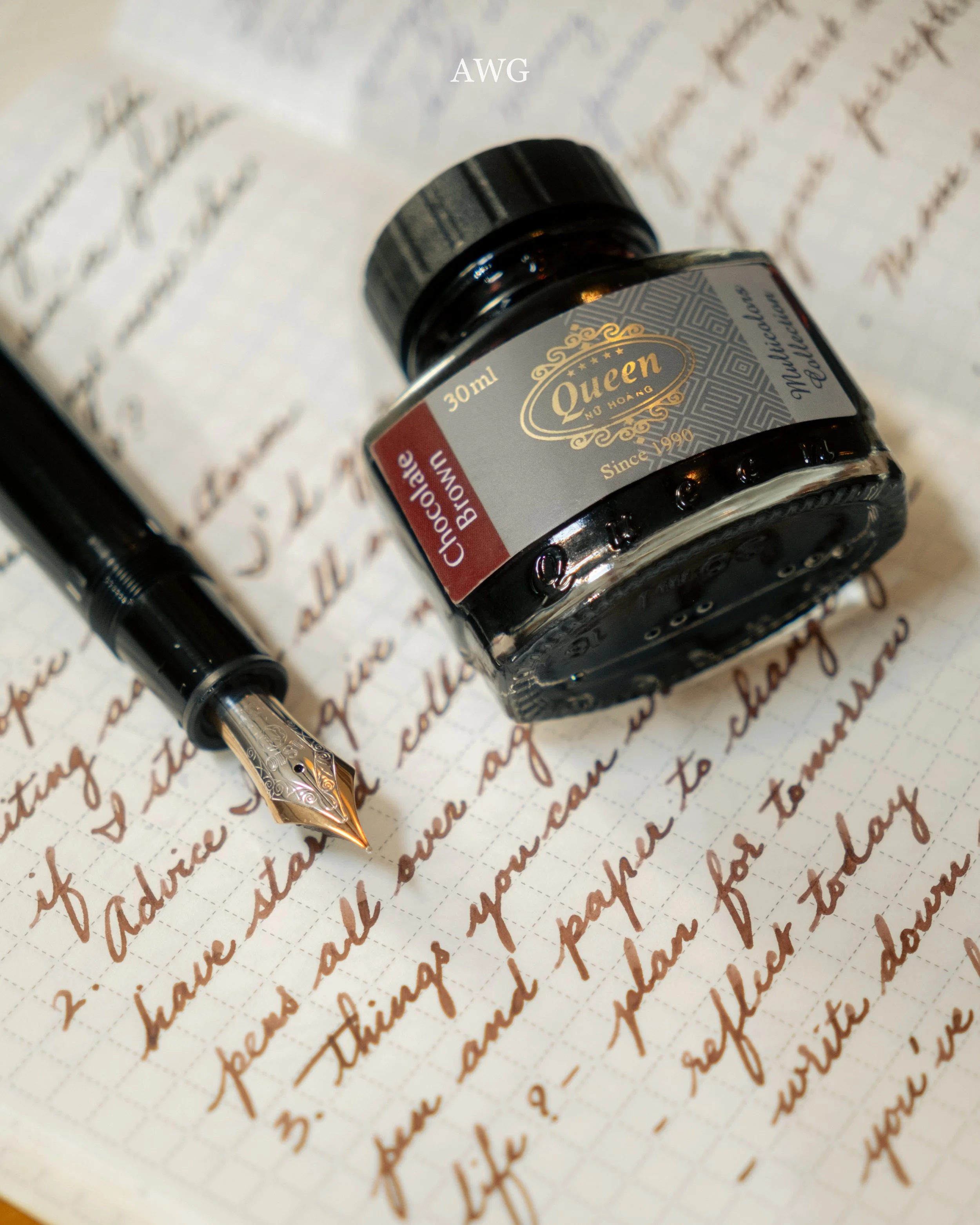
Nếu để ý thì gần như thú chơi nào cũng có một cái “hố” mà các bạn rất dễ rơi vào.
Chơi đồng hồ thì săn máy Thụy Sĩ. Chơi máy ảnh thì mê Leica. Chơi bàn phím thì săn switch hiếm. Còn chơi bút máy thì sớm muộn gì cũng sẽ đến giai đoạn ám ảnh với ngòi flex.
Mình cũng không ngoại lệ.
Ngày trước cứ mở Instagram lên là thấy những nét Copperplate mềm như lụa. Xem YouTube thì video nào cũng nói về độ đàn hồi, độ mở ngòi, cảm giác “mềm như bơ”. Lên hội nhóm thì ai cũng bảo phải kiếm được một cây Waterman vintage hay Mabie Todd thì mới biết flex thật sự là gì.
Nghe nhiều quá thì mình cũng tin.
Mình bắt đầu nghĩ chắc chữ mình chưa đẹp là vì… chưa có đúng cây bút.
Rồi bắt đầu mua.
Mua xong thì lại đọc được bài viết nói có cây khác mềm hơn. Mềm hơn nữa thì lại xuất hiện một cây vintage. Rồi người khác lại bảo vintage vẫn chưa đủ, phải đúng đời này, đúng ngòi này, đúng feed này mới ra hết chất.
Ban đầu mình tìm đến bút máy vì viết bút bi cực quá. Một thời gian sau thì thứ mình làm nhiều nhất lại là đọc review, xem video so sánh và lên diễn đàn hỏi xem có nên đổi feed ebonite không. Có hôm ngồi cả buổi tối đọc về cách chỉnh ngòi mà đến cuối ngày chẳng viết nổi nửa trang giấy - nhìn lại thì chỉ toàn những trang quẹt mực chỉ để chỉnh được cái ngòi cho đúng ý.
Lúc đó mình mới nhận ra là mình vẫn dành thời gian cho sở thích của mình, nhưng lại không dành thời gian để… viết.
Một video mười giây kéo nét bằng ngòi flex với mực nhũ sẽ luôn đẹp hơn cảnh ai đó ngồi viết ba trang nhật ký bằng một cây Pilot bình thường. Điều đó chẳng có gì sai, vì nội dung thu hút thì sẽ có nhiều người xem hơn. Chỉ có điều xem nhiều quá thì mình bắt đầu mặc định rằng đó mới là đích đến của việc chơi bút.
Trong khi thực tế thì phần lớn chúng ta chẳng viết như vậy.
Mỗi ngày mình vẫn ghi chú, lên ý tưởng, viết giáo án, ký tên, viết thư hoặc ghi vài dòng vào sổ. Những việc đó không hề cần một cây flex. Thậm chí nhiều khi một cây ngòi cứng vừa phải còn cho trải nghiệm dễ chịu hơn rất nhiều vì mình không phải để ý xem lực tay hôm nay có đều không, giấy có chịu được không hay mực có theo kịp không.
Một cây bút tốt, với mình, là cây bút khiến mình quên mất nó đang ở trên tay.
Sau vài dòng đầu tiên, mình không còn nghĩ đến ngòi nữa. Mình chỉ nghĩ đến việc mình đang viết gì. Ý tưởng chạy nhanh thì tay cũng chạy theo. Không cần canh lực, không cần cố tạo nét thanh nét đậm, cũng không cần lo mỗi chữ có đang đủ đẹp để chụp hình đăng mạng hay không.
Đó là lúc mình thích viết nhất.
Điều mình thấy đáng tiếc là nhiều người mới lại dành rất nhiều thời gian để đi tìm nét thanh nét đậm, trong khi thứ làm nên một nét chữ đẹp lại nằm ở những thứ lặp đi lặp lại khác cơ.
Khoảng cách giữa các chữ.
Nhịp của từng dòng viết.
Độ nghiêng có ổn định không.
Các chữ có nhìn như đang cùng một thể thống nhất hay mỗi chữ một nẻo.
Mấy thứ đó nhìn thì chán, tập cũng chán, nhưng lại là nền móng của mọi kiểu chữ đẹp.
Flex không tạo ra được những điều đó.
Nó chỉ làm phần đẹp trở nên nổi bật hơn, còn phần chưa ổn thì vẫn ở đó.
Thật ra mình vẫn rất thích ngòi flex.
Thỉnh thoảng lấy ra viết vài dòng Copperplate vẫn vui như ngày đầu. Cảm giác điều khiển được độ dày mỏng của từng nét vẫn rất đã, và mình hoàn toàn hiểu vì sao nhiều người mê nó.
Chỉ là bây giờ mình không còn nghĩ nó là đích đến nữa.
Nếu ngày mai tất cả ngòi flex trên thế giới biến mất thì mình vẫn sẽ ngồi xuống viết như mọi ngày.
Có lẽ đó mới là điều mình muốn giữ từ thú chơi này, mà là cảm giác luôn muốn mở sổ ra và viết thêm một trang nữa.
